
SOMETHING I SAID
A lecture from Southwark Cathedral

Christmas books!
Signed copies of the new special edition of The Hollow Crown (delivered worldwide)
Bespoke dedicated signed copies of any of my books (UK only)
Or come see me in Waterstones Piccadilly, London on December 4th, from 6.30pm
Last week I gave the Churches Conservation Trust’s annual lecture in Southwark Cathedral. It was a fine evening - as I think some readers of this newsletter know, because you were there, among a crowd of more than 300 people.
Thank you all for coming.
Southwark Cathedral has a long history, tangentially connected in a number of ways with Henry V.
It’s also just a very beautiful space, and there are some great things to see there, including the tomb of the great scholar-bishop Lancelot Andrewes and a statue of Shakespeare, with his elbows and knees buffed shiny by vistors giving him a good-luck rub.
Anyway, my talk was about Henry V, a story I tried to connect to three of the 359 historic churches the CCT looks after. I wrote it bespoke for the evening, and I doubt I’ll ever deliver it again, so I thought that, for posterity, you might like to see it.
This is the text I spoke from. I ad libbed it here and there on the night, but you’ll get the idea. I’ve also added pictures so you can see the churches I mentioned.
Enjoy!
Dan
Good evening, ladies and gentlemen.
It’s a privilege and a great pleasure to be here tonight to speak to you all. I’m thrilled to see Southwark Cathedral so full of friendly faces.
Now, I’m personally very happy to be here because in the Middle Ages — where we’re going to spend the next hour or so — Southwark was renowned as the place to go for hijinks and low living.
As the Miller in Chaucer’s Canterbury Tales says: “If that I misspeke or say / wite it the ale of Southwark, I you pray.”
Southwark — London’s seedy suburb on the south bank of the Thames — was a place of strong beer, grubby bathhouses, and brothels. Dens of iniquity and temples to insobriety.
To quote Frank Sinatra: my kinda town.
Southwark’s disgraceful reputation was well known to Henry V — about whom I’m going to be talking tonight. In fact, being strait-laced and God-fearing, Henry closed down the bathhouses of Southwark on the eve of his departure for one of his three great military campaigns to France. Of course, he left the churches open.
But this was not Henry’s only connection with Southwark.
In his time, this cathedral was a church dedicated to St Mary, standing right beside the only bridge leading into the City of London.
Had we been here in the early fifteenth century, we could have witnessed Henry marching out of London to go on campaign.
We could have seen him parade back into London in triumph after his victory at Agincourt in 1415 — and again in 1421, after securing his right to inherit the French crown with the Treaty of Troyes.
In 1422, we might have seen Henry’s funeral cortege pass this very spot — after he died aged thirty-five and his body was brought back from Paris for burial in Westminster Abbey.
In 1423, we might have come here to see Henry’s first cousin, Joan Beaufort, marry King James I of Scotland — who had been for many years Henry’s prisoner.
And had we visited in the late sixteenth century, we might have bumped into this parish’s most famous parishioner: William Shakespeare — whose plays featuring Henry are responsible for so much of his reputation.
So this is, on many grounds, a fine place to be talking about Henry V — England’s greatest warrior king. I’m delighted that the Churches Conservation Trust have invited me to do so this evening.
I’ll now say a few words about his origin story, his reputation, and the glimpses of his world that we can still see in our own.
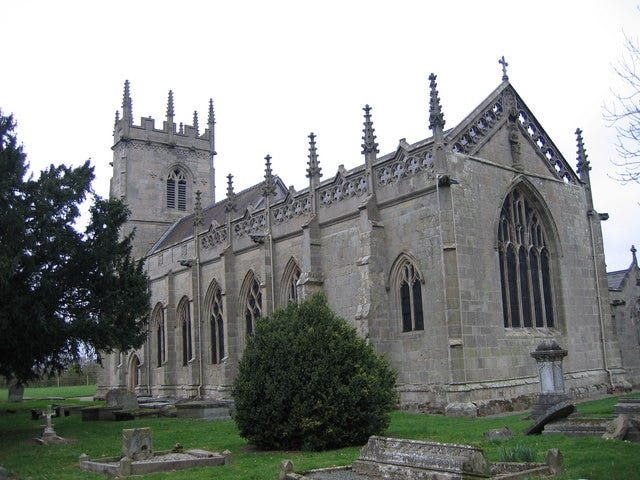
Where I want to begin tonight isn’t in Southwark, but about 175 miles northwest of here, in a smaller church, dedicated to another Saint Mary.
That’s the Church of St Mary Magdalene at Battlefield, just outside Shrewsbury in Shropshire — which is looked after by the Churches Conservation Trust.
Keep reading with a 7-day free trial
Subscribe to History, Etc to keep reading this post and get 7 days of free access to the full post archives.